Winter break and storage
Make the system frost-safe — sensors out, water out, everything stored dry
Water expands when it freezes. In pumps, hoses and the suction filter a single frosty night is enough to burst a part — and the damage often only shows up in spring, when water starts leaking somewhere.
The device is built to run through the season, not to spend the winter outdoors. Frost damage is not a material or manufacturing fault and therefore not a warranty case — that goes for pumps, hoses and the device just as much as for the sensors. The sensors are the most delicate part: they sit permanently in damp soil, and when that freezes the ice presses on the sensing area and the cable gland. Taking them out before the first frost is the single most effective thing you can do.
WHEN: as soon as night frosts are forecast. Two weeks too early beats one night too late.
1Stop watering
Deactivate all zones so nothing starts up while you are dismantling.
In the app
Per zone: zone detail view → switch off "Zone active". For all at once: Settings → expand "Maintenance" → maintenance mode.
On the device
Settings → switch on maintenance mode — it pauses every zone at once.
See also: Maintenance mode
2Sensors out of the soil
Pull the sensors out carefully — by the housing, not by the cable. Rinse off the soil, dry them, unplug the USB-C connector.
Stubborn crusts come off with a little isopropyl alcohol on a cloth. Then coil the cables loosely; do not kink them.
Caution
NEVER pull a sensor out of frozen soil and never leave it in. Frozen soil holds the sensor fast; pulling tears the cable gland — that is the most common winter damage.
See also: Understanding & checking sensors
3Empty the tank and pull the suction hose
Empty the water tank completely and take out the suction hose with its suction filter. There is water sitting inside the filter — shake it out and let it dry.
4Drain pumps and hoses
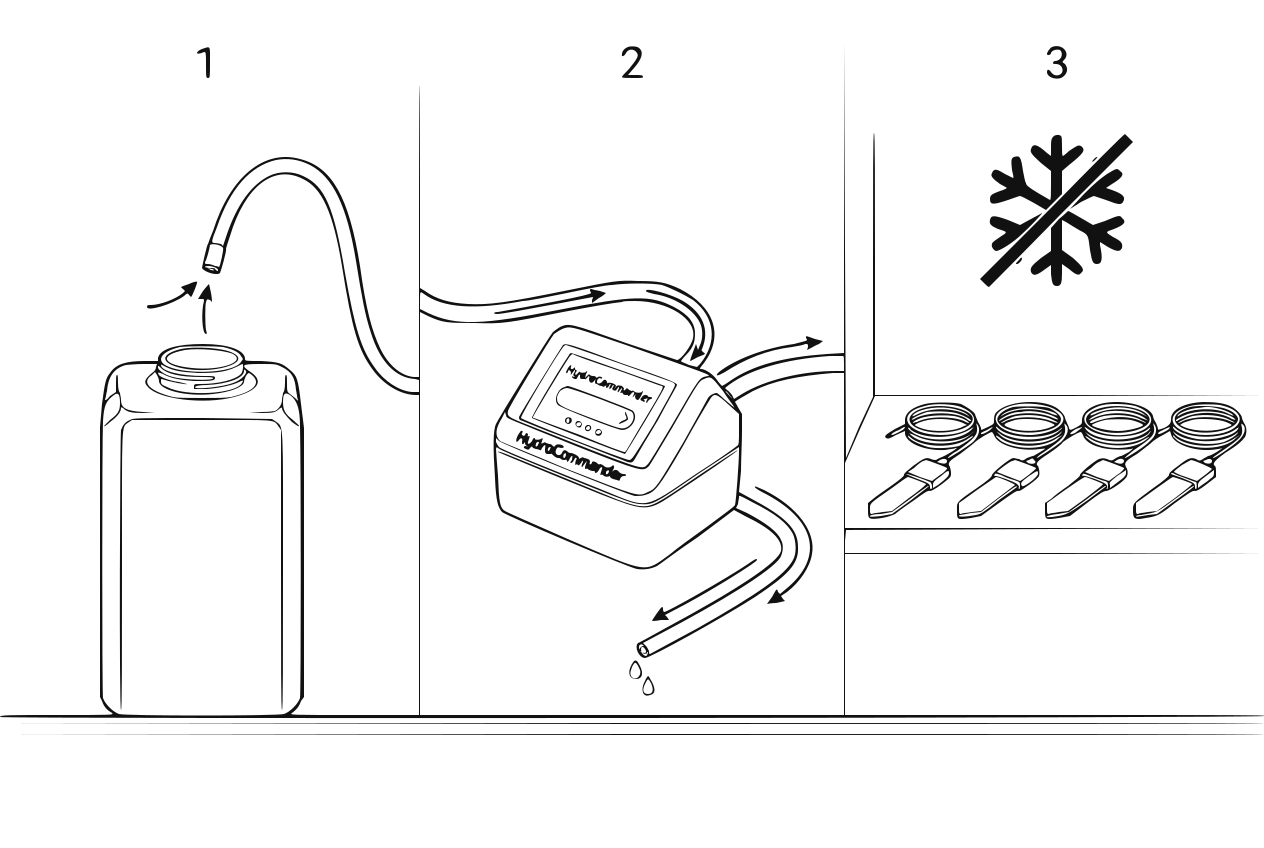
Winterized: tank empty, hoses drained, sensors stored dry The most important step against frost damage: the remaining water has to come out of the pumps and hoses.
Take the suction hose out of the tank first, otherwise the device empties the tank instead of the hoses. The draining function does the rest: it pumps the selected zones for 60 seconds at a time with pauses in between — at most two at once, with three or four zones in pairs taking turns. It keeps going until you stop it, for at most 30 minutes of pumping per zone; once only air comes out, stop it – after about a minute of only air it stops by itself. Let the hose ends hang down while it runs so the water drains off.
In the app
Settings → expand "Maintenance" → "Empty pumps and hoses" → select zones → "Start draining". It runs through on its own and can be stopped at any time.
On the device
Tank → "Drain" → select zones → "Start drain".
Tip
Diaphragm pumps move air as well — that is why blowing the lines out works at all, and why running dry does them no harm while it happens.
5Take the device down and store it dry
Unplug the power supply, pull off the hoses, bring the device somewhere dry. The housing is not weatherproof — a cellar, garage or storage room is right; an unheated greenhouse full of condensation is not.
Store sensors, distributors and hoses together with the device, then everything is in one place come spring.
6Set it up again in spring
Before the first start: check the hoses for cracks, check the suction filter for blockages, put everything back together as you did the first time.
A fresh calibration is recommended afterwards — not mandatory, but the hoses rarely end up routed exactly as before, and the flow rate depends on their length and routing. Finally, switch off maintenance mode and switch the zones back on.
See also: Calibrate pump · First steps
WHAT HAPPENS IF YOU FORGET
- Frozen water in the pump splits the diaphragm — that zone then delivers nothing, or leaks.
- A full suction filter bursts and draws air in spring without anything being visible from outside.
- Sensors in frozen soil crack at the cable gland. Their readings then jump around or drop out entirely.
IF FROST IS COMING AND YOU ARE IN A HURRY
The two things that matter most: sensors out, and water out of the pumps. Everything else can wait.